
Leaders Don’t Drop Off in Week One. They Drop Off in Week Eight.
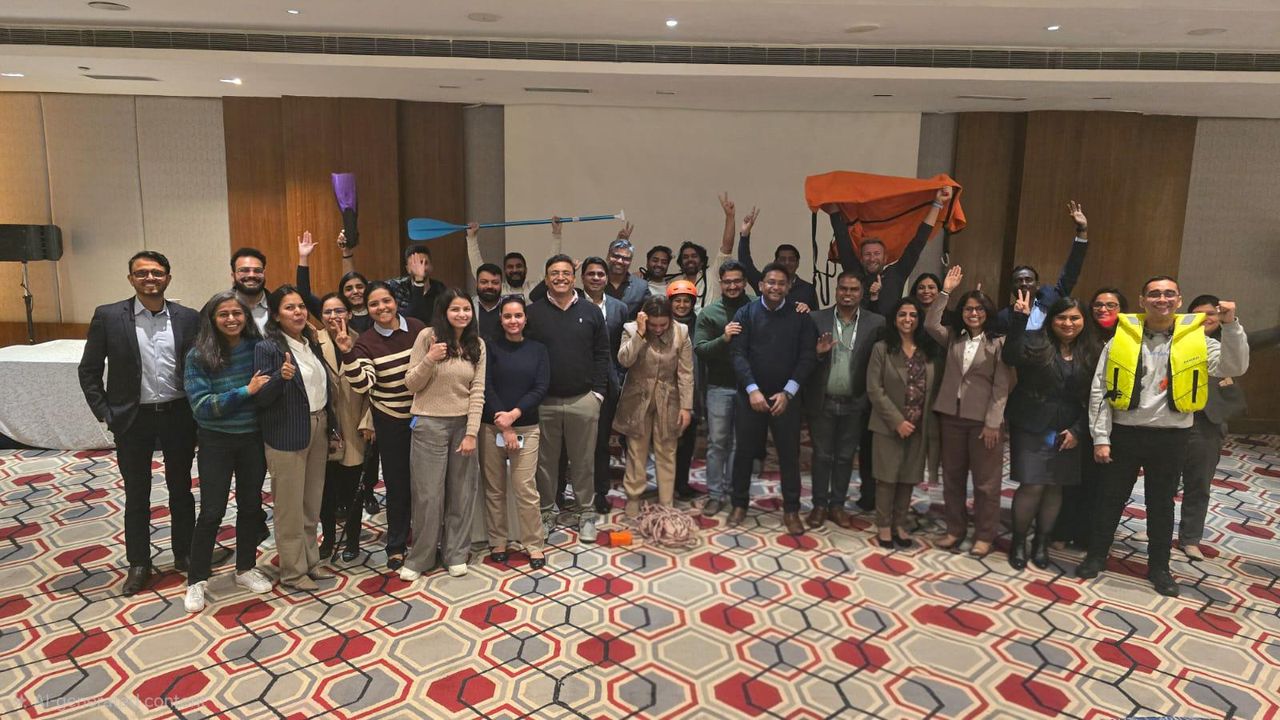
Most leadership programmes lose momentum around month three. The room goes quiet, calendars fill back up, and the learning gets buried under email. Cisco’s Horizons programme has run two cohorts over six months each without that drop-off, and the reason isn’t more content. It’s how the gaps between sessions are designed.
Why six-month leadership journeys fall apart in the middle
A one-day workshop is easy to sustain. Everyone shows up, everyone’s present, the energy carries itself. A six-month journey is a different problem. Somewhere around week eight, the launch-day energy fades, the leader’s actual job reasserts itself, and the programme becomes one more thing competing for a slot in a global working week that was never built to accommodate it.
Most programmes respond to this by adding more content. More modules, more reading, more reminders. It rarely works, because the problem was never a content gap. It’s a momentum gap.
Anchor the middle, not just the ends
Cisco needed leaders developed at three levels: self, team, and the ambiguity ahead of them. A single workshop can address one of those. It can’t hold all three across half a year without a structure underneath it.
The fix was to stop treating the space between sessions as dead time. Explore Performance built Horizons around three expedition-anchored phases, each tied to a distinct level of leadership development, and connected by virtual team coaching and feedback loop sessions over Webex. The gaps between the in-person moments weren’t gaps at all. They were where the actual behaviour change had to happen, because that’s where leaders are back in their real jobs, under real pressure, making real decisions.
Real stakes teach faster than case studies
The middle phase draws directly on Grant ‘Axe’ Rawlinson’s Everest expedition to work through decision making under VUCA conditions and what makes a team antifragile. That’s a deliberate choice. Leaders forget frameworks. They remember what it felt like to watch a team make a call with incomplete information and real consequences.
This is the same principle behind every EP programme: the classroom that actually changes behaviour is the one grounded in genuine pressure, not the one with the best slide design.
Global calendars need local rhythm
A programme built for a global working week can’t assume everyone’s available at the same time or in the same room. Horizons solved this by making the virtual check-ins short, frequent, and coaching-led rather than content-led. Momentum doesn’t need another long session. It needs a consistent pulse.
What held?
Two cohorts in, the pattern has repeated. Leaders arrive at the second in-person phase further along than a six-month gap would predict, because the middle did its job. The clearest proof of a programme working isn’t the feedback form at the end. It’s a client asking to run it again.
Full detail on how Horizons was built is in the Cisco case study.
FAQ
Q Why do leadership programmes lose momentum, if not from lack of content?
A Momentum is lost in the gaps between sessions, not in the sessions themselves. Without structure connecting the phases, leaders default back to old patterns the moment the room empties.
Q How long should a leadership journey run before it risks losing engagement?
A There’s no fixed number, but multi-month journeys need a mid-programme structure by design, not as an afterthought. Six months without connective tissue between phases is a difficult ask of any working leader.
Q Does virtual coaching actually sustain behaviour change, or is it a placeholder for in-person time?
A Short, consistent virtual check-ins outperform infrequent long ones because they match the rhythm of a real working week rather than asking leaders to carve out large blocks they don’t have.